



How to Produce a Interesting Secure Live StreamEngaging Secure Live StreamMemorable Secure Live StreamReliable Secure Live StreamWorth While Secure Live StreamImmersive Secure Live Stream Cutting Edge Secure Live StreamImpressive Secure Live StreamHigh Quality Secure Live Stream ,Best Practices
Secure Live Streaming Video is required in any number of scenarios for different purposes, most commonly Internal Communications, but by no means exclusively. If you’re responsible for producing internal meetings, business updates, or sharing confidential content within your organization and between remote offices and employees, you will need Secure Live Streaming Video. This is an especially critical step if you are producing events offsite that require livestreaming back to base into that network of locations.
Restricting your Content to a defined audience is only part of the picture. Producing End-to-End Secure Live Streaming that is less vulnerable to man-in-the-middle attacks, eavesdropping or IP Spoofing, takes planning and resources. There are security considerations at every step of the signal path, choosing a Video Encoder, choosing a Streaming Software and Distributor (SVP/CDN) need to be weighed against other production priorities and budget contraints. For all of the different ways to configure production for a Live Stream, there are ways to be more or less secure. In this post, we’re exploring best practices and sharing some behind the scenes secrets to fold into every workflow.
eCDN, Enterprise Content Delivery Network(s) for Secure Live Streams
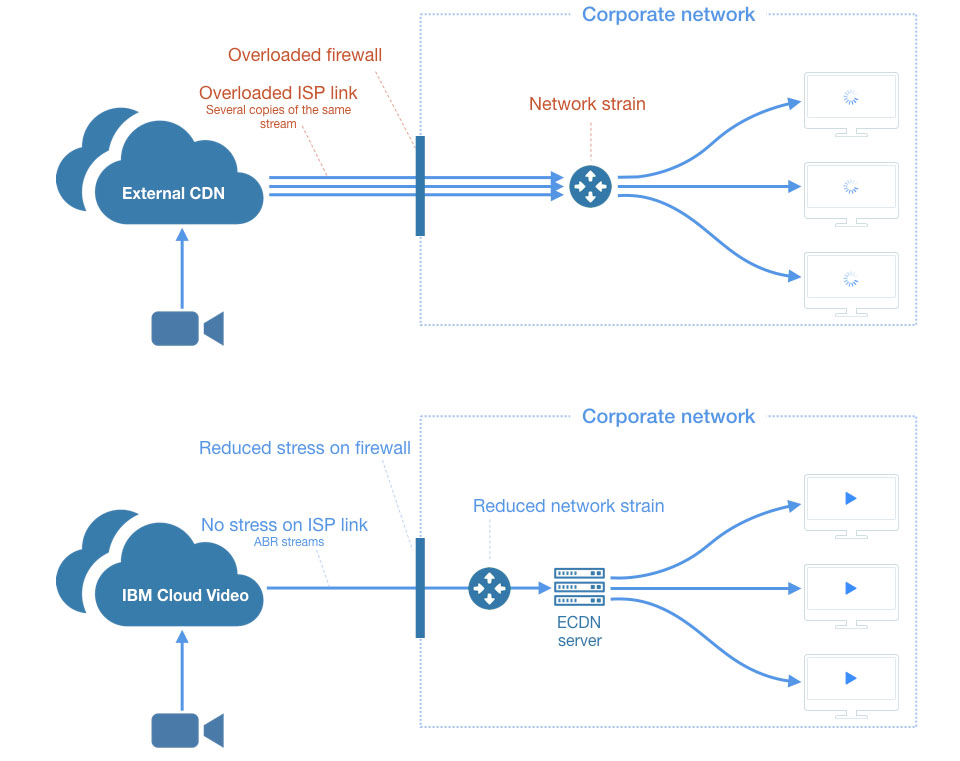
An ECDN is security-enhanced video delivery deployed inside corporate firewalls. No inbound connection(s) from the Internet means bulletproof secure live stream transmission for your broadcast or event.
As you can see in the Network diagram (Infographic Credit: IBM Watson Media), the primary purpose of an ECDN is to deliver stable video streaming to any place with a high number of concurrent viewers, such as a corporate office, government building, college or school, and enhanced security sort-of ‘comes along for the ride’.
ECDN solutions are in place in many larger organizations, experienced Live Stream Production Partners will be able to handshake with the internal solution within your network. From remote locations your Live Stream Production partner will send an encrypted signal to the ECDN server, creating a Secure Live Stream from origin to all destinations.
Video Encoders and CDN, Content Delivery Network(s)
Content Delivery Networks or CDN’s are physically distributed networks of proxy servers used to deliver a wide range of services and data; Internet Content, Software, Files, Media, and most importantly Video. Live Stream Video Service providers (SVP’s) are integrated with one of many Commercial CDN’s like Akamai, Amazon Cloudfront, IBM Watson Media, and Level 3/Century Link. Purpose-built video streaming services such as Brightcove, Livestream, and Wowza sit on top of these large commercial CDN’s. Depending on how often you’re Livestreaming Events, a subscription account with an SVP provider might make economic sense for your organization. If not, a Live Stream Production Company partner should be able to include an SVP/CDN setup fee for a one-time event.
There are two important parts to consider; Video Encoders and Streaming Video Provider CDN’s. There are numerous free software video encoders available that will create a streaming signal and deliver it to a content delivery network: Handbrake and OBS are among the most well-known. There are also prominent licensed applications on the market Wirecast, Livestream Studio, VMix, and Xsplit to name but a few, and these Software Video Encoders often come bundled with an SVP/CDN account. This bundle approach may come with unfortunate limitations, different Encoders have differing features that might not be appropriate for every situation. Different CDN’s have different fee structures, bandwidth limitations, and storage allowances to take into account.
SVP/CDN’s generally provide robust security to the destination player, your streaming video will be secure on the distribution side provided the player is hosted securely. See the next section on “Microsites, Firewalls, Password Protection, Referrer Restrictions” to understand how to host a third party CDN player securely. Securing the contribution stream – from the Video Encoder to the CDN – is a challenge with a number of emerging solutions. See the section on “RTMPS” and the section on “Youtube, Periscope, Twitch and Private Live Streaming…” You might be quite surprised by our conclusions about Secure Live Streaming Video with these services.
Microsites, Firewalls, Password Protection, Referrer Restrictions

The most straight forward Secure Live Stream is behind Company Firewalls accessible only on the Company Network with Domain credentials (SSO, SSL, TSL). Most commonly a Microsite page designed specifically for the event will be used, with the Live Stream Video Player embedded into the site. Microsite event pages will include additional event information, follow up CTA’s, survey requests, and Q&A options can be built in too. An experienced live stream production company will develop this end to end, and partner with your IS/IT team to host it behind your existing firewalls and security.
A microsite is an option outside of a company domain too, with varying levels of security. Setting up a Player Page securely outside of a domain requires other types of authentication. Good old fashioned Password Protection is an option, your audience will be required to sign in or register to access the video content. More secure than Password Protection is ‘Domain’ or ‘Referer Restrictions’, this configuration only allows connections from a specifically selected domain or domain(s) to access the content OR only allows the Player to be embedded into specific websites.
Security features vary from CDN to CDN and may or may not be offered by your CDN Provider, thorough research is necessary to ensure the CDN account you buy has the type of security features you want or need. Sidenote: a Paywall offers similar protection to Password Protection, but a paywall is less appropriate for the types of internal communications content we’re discussing and “paywalls and monetizing your livestream” is a topic for another post (Coming Soon!).
RTMPS | Secure Live Streams
Real-Time Messaging Protocal SECURE.
“Once a live stream enters the public internet, it’s vulnerable. Securing the contribution stream can help prevent spying, spoofing, and man-in-the-middle attacks. While the RTMP protocol quickly transports live streams to YouTube, Periscope, and Twitch — it’s not all that and a bag of chips when it comes to security.” Traci Ruether Wowza Media Services
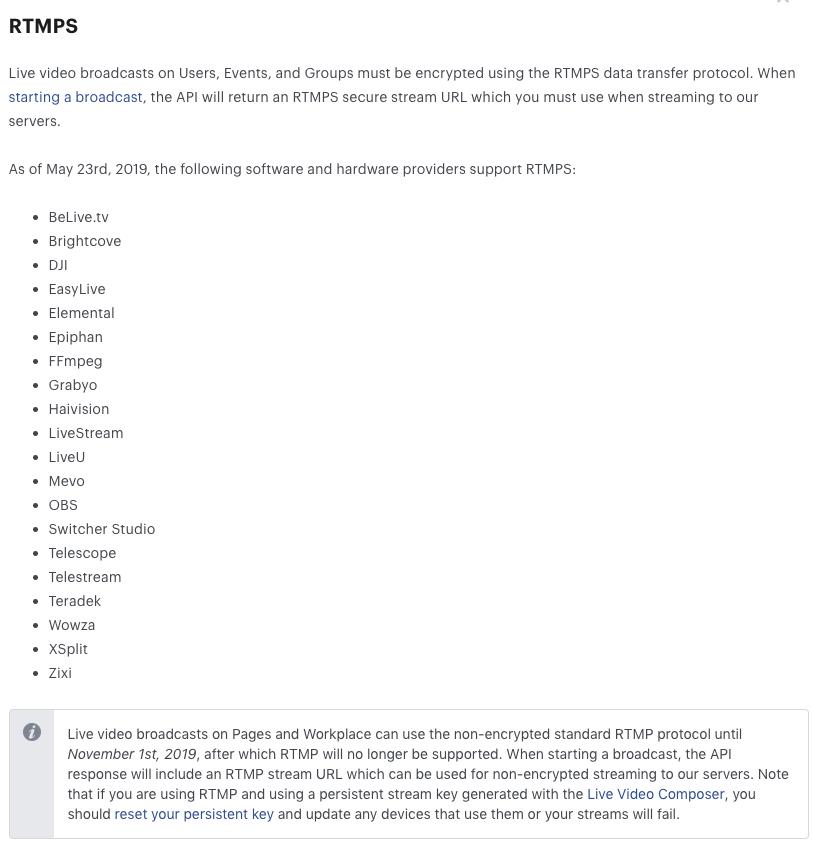
If universally-trusted software like VLC can be dangerous… you never know where a threat will come from next. RTMPS is encypted Video over a secure connection and Encryption works! Facebook now requires it for streaming video to their platform. Some of the leading Software Encoders and SVP’s support RTMPS (see the sanctioned list from Facebook to the right). But not all, if Facebook is in your live stream destinations mix, make sure your Encoder supports it. For Secure Live Streams such as Internal Meetings, you will be using a CDN player and a Microsite, which will be secure if you follow the steps in the section “Microsites, Firewalls, Password Protection, Referrer Restrictions”.
The next section covers Secure Live Streaming with Online Video Platforms (OVP’s) and Social Media such as, Youtube, Periscope, Twitch, and more…
Youtube, Periscope, Twitch and Private Secure Live Streaming…

Facebook recently migrated to RTMPS Servers, and they are leading the industry in that regard. Youtube, Twitch, Periscope, Daily Motion, Vimeo (even with Livestream Studio, which does support RTMPS for Facebook), do not support RTMPS Streaming. While it is possible to stream privately or unlisted to most of those services, and thereby restrict your audience, there is no way setup a truly Secure Live Stream using these OVP’s. For any scenario where security is a priority, the bottom line is, you cannot use these services! End of Story.
Conclusion…
For most live streaming projects, the idea is to attract more viewers not prevent access. But for the instances where Secure Live Streaming is required, options are available. If you have any questions, feel free to reach out to us here at Repertoire Productions, we love talking production and we are always glad to offer advice about all types and configurations for Live Streaming.
